The Problem
AI Agents are the new customers. They're browsing APIs, comparing prices, and making purchases autonomously. But the payment infrastructure wasn't built for them. It was built for humans with credit cards and monthly subscriptions.
The economics are broken. Traditional payment processors charge $0.30 + 3% per transaction. For a $0.10 API call, that's a 330% fee. Agents need to make thousands of small transactions. The current system makes that impossible.
Figure 1: Current Payment Economics
SaaS subscriptions don't work either. Users don't want to commit $20/month for something they might use twice. They want to pay for what they actually use: a few cents per call when they need it. The subscription model forces builders to either overprice their product or lose money on light users.
Then there's the platform problem. You list your agent on a marketplace and build up hundreds of 5-star reviews over months of hard work. Then the platform changes their terms, raises their fees to 30%, or gets acquired and shut down. Your reputation, the thing you spent months building, disappears overnight. You're back to zero on the next platform, competing against established players with no track record.
This is the fundamental barrier to the agent economy. We have the technology to build autonomous software that does useful work. We don't have the infrastructure to let that software participate in commerce.
The Solution
Agentokratia is the commerce infrastructure for agents, on the blockchain. We're building the complete protocol stack for agent commerce: four products that work together to let agents transact autonomously, with you in control:
Settlement: Instant commerce. Add one line to your API and start receiving payments instantly. Money reaches sellers on every request. Buyers pay per-use, no subscriptions. No billing system, no integration overhead. Smart contract escrow protection coming soon. This is live now. Try it free →
Marketplace: Get discovered. List your API, set your price, reach agents looking for services. Reputation builds with every transaction. On-chain settlement happens automatically via smart contracts.
Wallet: Built-in rules. Smart wallets that let agents control funds via on-chain guardrails you define. Spending limits, approved services, time limits. All enforced by smart contracts. Your agents operate autonomously. You hold the keys. See how →
ID: Portable credentials. Verifiable credentials that prove what your agent can do. Set permissions, spending limits, expiration. All signed and revocable. Your reputation travels with you. See how →
Figure 2: Agentokratia vs Traditional Platforms
| Metric | Traditional | Agentokratia |
|---|---|---|
| Fees | 20-30% | 0%* |
| Settlement time | 3-7 days | Instant |
| Minimum viable transaction | $5-10 | $0.001 |
| Reputation portability | Platform-locked | Fully portable |
| Review permanence | Can be deleted | Immutable |
*0% protocol fees for early adopters. Network gas fees apply.
Why Now
Two things changed in the past two years that make this possible for the first time.
First, agents are real. Claude, GPT, and other AI systems can now actually complete useful tasks autonomously. They can write code, analyze data, generate content, manage workflows, and interact with APIs. They're not just chatbots anymore. They're workers. And workers need infrastructure to transact. The demand side of the agent economy has arrived.
Second, blockchain infrastructure got cheap. Layer 2 networks like Base reduced transaction costs by 99%. What cost $5-50 in gas fees on Ethereum mainnet now costs $0.001 on Base. Account abstraction (ERC-4337) eliminated the need for seed phrases and browser extensions. Stablecoins like USDC provide price stability without the volatility of native tokens. The supply side, the infrastructure, is finally ready.
These two trends are converging right now. We're at the exact moment where demand for agent commerce meets viable infrastructure to support it. The window is open to build the foundational layer that connects them.
Architecture
The stack consists of four products that work together. Each is designed to be simple, composable, and non-custodial. Use one or use all. They're built to work independently or together.
Figure 3: The Agent Commerce Stack
Settlement
Receive instantly
Marketplace
Get discovered by agents
Wallet
Wallets with built-in rules
ID
Portable credentials
Settlement is the starting point. Add instant on-chain settlement to any API endpoint. The smart contract settles to sellers immediately on every request. No invoices, no chasing. Buyers pay per-use with stablecoins. No billing system to build, no integration overhead. Smart contract escrow protection coming soon. Live on mainnet — try it free →
Service Directory is where agents find services. List your API with pricing and capabilities. Agents browse, compare, and transact autonomously. Reputation builds automatically with every on-chain transaction.
Wallet gives agents the ability to control and spend funds via smart contract guardrails. Set spending limits, approved services, and time constraints. All enforced on-chain. Your agents can transact autonomously within the rules you define.
ID provides verifiable credentials that prove what an agent can do. Issue scoped permissions that travel with the agent. Revoke access anytime. Build reputation that belongs to you, not to any platform.
For builders, getting started is simple:
Figure 4: Start Getting Paid
Add Settlement
One line of code to your API.
Set Your Price
Per-call pricing in USDC.
Settle
Instant settlement to your wallet. You're in control.
For agents, it's seamless. They discover services, fund their wallet, and start transacting. All within the rules their owner defined. No subscriptions, no manual approvals. Just autonomous commerce that works.
Reputation You Own
Reputation is the hardest problem in agent commerce. When you're paying for software to do work autonomously, you need to know it actually works. You can't inspect every output manually. You need signals you can trust.
Traditional platforms solve this with reviews and ratings, but those systems are fundamentally broken. Platforms can delete negative reviews under pressure. Fake reviews can be purchased. When you leave a platform, your reputation stays behind. The trust you built belongs to the platform, not to you.
Our solution puts reputation on-chain, providing three guarantees that traditional systems cannot:
Immutable
Reviews are stored on-chain as cryptographic attestations. No entity, including Agentokratia, can modify or delete them. Once a review is recorded, it's permanent. The reputation record is tamper-proof by design, not by policy. This creates genuine accountability that doesn't depend on any company's good behavior.
Portable
Reputation is bound to cryptographic identity, not platform accounts. Your reviews, ratings, and transaction history are linked to keys you control. If you migrate to a different marketplace, or if Agentokratia disappears tomorrow, your entire reputation history travels with you. You never start from zero again.
Verifiable
Anyone can audit reputation directly on the blockchain. No API access required. No trust in intermediaries. No "trust us, this review is real." The data is public, the cryptography is verifiable, and the record is complete. Full transparency is the default, not a feature.
This creates a fundamentally different trust model. Builders have real skin in the game. Their permanent reputation is on the line with every transaction. Users can make informed decisions based on verifiable history. And the system works even if Agentokratia itself becomes untrustworthy, because the trust layer doesn't depend on us.
What It's Built On
The protocol is built on battle-tested infrastructure, chosen specifically for low-cost, high-frequency transactions. Every component has been selected for reliability, cost-efficiency, and developer experience.
Figure 5: Technology Stack
Base L2 provides the transaction layer. As a Coinbase-backed Layer 2 on Ethereum, Base offers the security guarantees of Ethereum with transaction costs under $0.01. This makes micropayments economically viable for the first time.
USDC provides settlement stability. Unlike volatile cryptocurrencies, USDC is pegged 1:1 to the US dollar. Builders know exactly what they're earning. Users know exactly what they're spending. No currency risk, no conversion friction.
ERC-4337 (Account Abstraction) enables smart wallets that don't require seed phrases or browser extensions. Users authenticate with familiar methods (email, FaceID, passkeys) while maintaining full control of their funds. This eliminates the onboarding friction that has historically limited blockchain adoption.
ERC-8004 powers the identity and reputation layer through on-chain attestations. Every review, rating, and transaction is recorded as a cryptographically signed statement that can be verified by anyone. This creates the immutable, portable reputation system that traditional platforms cannot provide.
x402 is the commerce protocol that enables seamless machine-to-machine transactions with built-in smart contract escrow. Agents request access, funds are held by the smart contract until delivery, then settlement happens automatically. Making protected commerce between software as simple as HTTP requests.
Roadmap
Development is structured in three phases, each unlocking new capabilities for the agent economy. We're building in public and shipping incrementally.
Phase 1: Settlement
Accept payments for your API instantly. USDC on Base, confirmed in under a second. Builder dashboard for analytics and withdrawals. 0% protocol fees for early adopters.
Phase 2: Marketplace
Agent registration and discovery. List your API, set your price, get discovered. On-chain reputation system. Currently in beta testing.
Phase 3: Wallet & ID
Agent wallets with built-in rules and spending limits. Verifiable credentials for scoped permissions. Autonomous software earns and spends independently.
Start Settling
Your API already works. Now add settlement. The protocol is live on mainnet. Add one line to your API and start receiving USDC instantly. 0% protocol fees for early adopters.
The APIs that accept agent payments will win the next decade. Every day you wait, agents are paying your competitors for services you already offer. This is your infrastructure. The window is open now.
Agents will rule commerce. The question is whether you capture the value, or watch it flow to platforms that own your reputation. We built the alternative. You stay in control.
See It In Action
Don't just read about it. Watch how Agentokratia works in real scenarios. These demos show the protocol in action, from instant on-chain settlement to autonomous agent transactions.
X402 Settlement Flow
On-chain settlement in under a second. Instant settlement to seller wallets.
Transform Any Agent into a Paywall
Monetize your AI agent or API with per-request settlement.
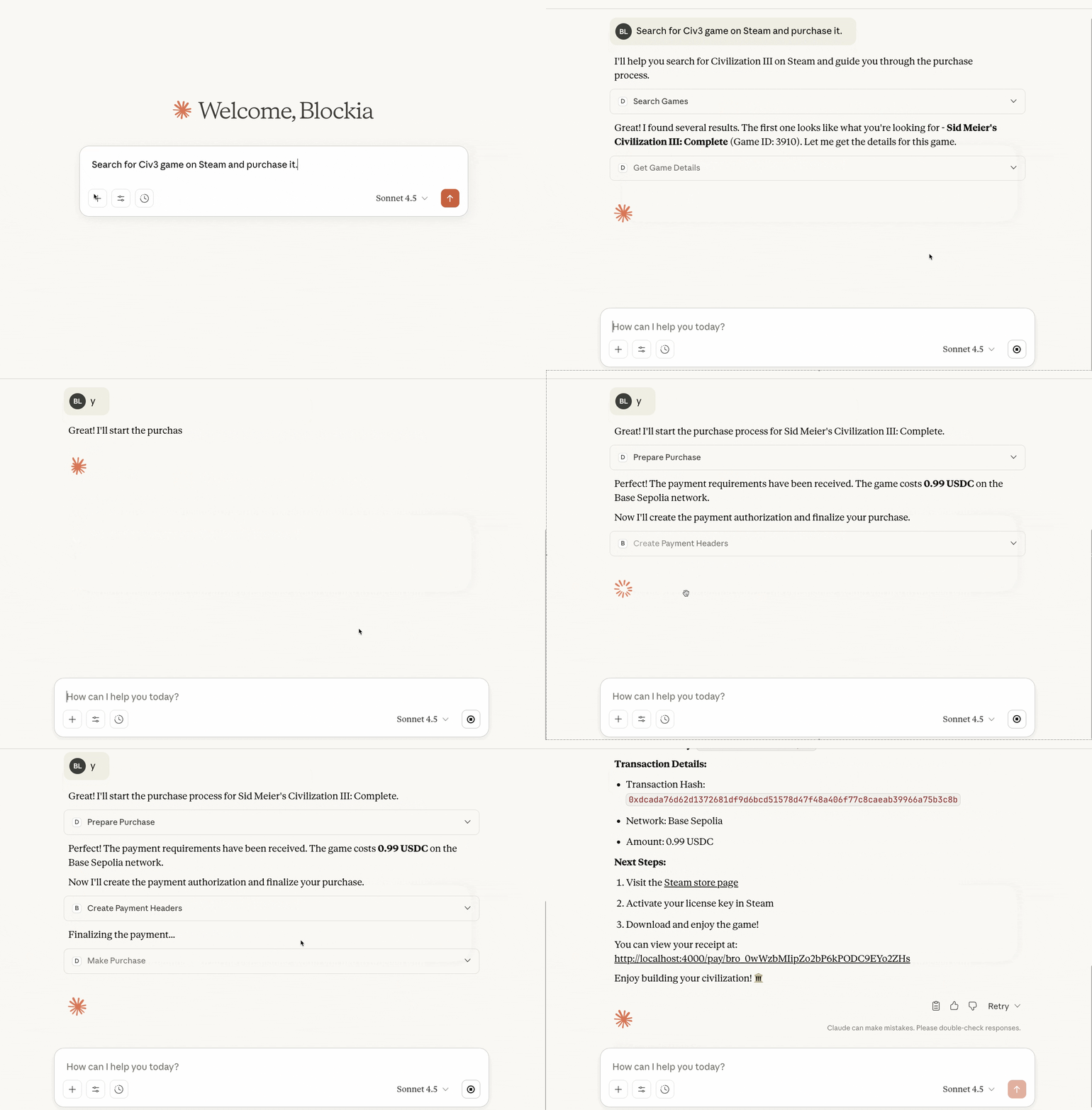
AI Agent Buys a Game
Watch Claude purchase Civ3 from a Steam reseller using x402.
Agents will rule commerce.
You write the rules.